

What the good teams have in common (it’s a shorter list than you’d think)
Last week’s Ataraxy Friday was about the Anna Karenina Principle: “All happy families are alike; each unhappy family is unhappy in its own way.” There are endless ways for things to go wrong and only a few ways for them to go right. Chasing down every way it could go wrong is exhausting, while building the few things that go right is simpler. This week I want to follow that thread more fully into leadership teams, because my industry has a habit of doing it the hard way. There are thousands of profiling tools, diagnostics and leadership models out there. Some are blunt and some are forensic. Many of them

What the good teams have in common (it’s a shorter list than you’d think)
Last week’s Ataraxy Friday was about the Anna Karenina Principle: “All happy families are alike; each unhappy family is unhappy in its own way.” There are endless ways for things to go wrong and only a few ways for them to go right. Chasing down every way it could go wrong is exhausting, while building the few things that go right is simpler. This week I want to follow that thread more fully into leadership teams, because my industry has a habit of doing it the hard way. There are thousands of profiling tools, diagnostics and leadership models out there. Some are blunt and some are forensic. Many of them

What Anna Karenina and Confucius have in common
“All happy families are alike; each unhappy family is unhappy in its own way.” That’s the opening line of Tolstoy’s Anna Karenina, and the seed of what’s become known as the Anna Karenina Principle. I’ll confess I met it through

FOMO, DOMO and a beer garden in Albury
Newcastle’s first grand final in 25 years, and I watched it from a beer garden in Albury. I’ve lived in Newcastle my whole life. I remember the last one, when the Knights won and a fair portion of the town

Why stress makes you a bad friend to your future self
Nobody has ever answered “If you only had twelve months to live, what would you do?” with “Get on top of my inbox.” Or “nurse a grudge.” Or “argue with strangers on X.” It’s one of the classic coaching questions,

Why less “I” is a happier Me
You know how kids see things in highly egocentric terms? Everything that happens is about them or in relation to them. As we grow, we tend to grow out of this, but not completely. When we’re tired, busy, stressed this

What’s a comfortable death for?
I see a lot of people focused on becoming. Eyes forward, reaching for the next level. How old were your kids when they took their first steps? Cool, what is the next progression marker? Are they advanced? Behind? What’s primary

What have you done for me lately
Many managers I’ve worked with have experienced a version of this soulless feelingless transactional interaction. The: “what have you done for me lately?” “Hey, fantastic month, great result. Now, what have you got for next month?” Or, “That was a

Nailing it? Meh? Or WTAF is going on?
How are you going? Happy, well, nailing it? Or meh? Or WTAF is going on!!!? Or somewhere in between? Want a quick check on the stuff that matters? The MyAtaraxy Quick Health Check. Fifteen YES/NO questions. Five minutes. A personalised
Old Foundations Modern Context
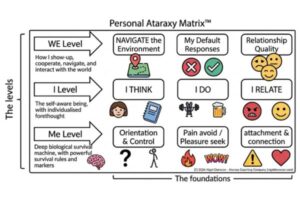
How does our deep biology and our sense of self contribute to how we think and ultimately how we interact with the world around us? I built the “Personal Ataraxy Matrix” below to help people connect their daily interactions with

When the first action isn’t an action at all
There’s a particular way dreams get crushed. Inaction obviously, but even before that, the dismissal of the idea in the first place. It usually happens when the gap between where you are and where the idea would take you is
What is the ROI on how I feel?
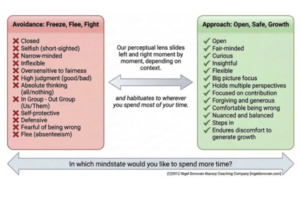
What is the ROI on how I feel? Absurd question, right? It is absurd because we shouldn’t attempt to quantify qualia. But it isn’t absurd, because it represents is a massive missing link that companies cannot see. Companies deal in

Hidden Cost of Gifts
When someone gives a gift, they create an invisible social obligation in the receiver — an implied debt that wasn’t asked for and can’t easily be refused. This piece explores the hidden psychological and relational cost of gifts and what

Attend, drift, avoid?
About 20 years ago I went through a phase of reading those North American motivational books — Napoleon Hill, Dale Carnegie, Emerson, Tolle, that whole shelf. One of them was Nathaniel Branden’s The Art of Living Consciously: The Power of

100% no failure rate
Coachy-mode unnamed dad to his daughter as she puts her boots on for soccer: “You miss 100% of the shots you don’t take.” Daughter with a grin that shows she’s too clever for her dad: “You can’t fail if you

Make rules like you weren’t the boss
New Rule! [specific words or gestures] are now a criminal offence. New Rule! I’m removing that guardrail and bending that rule — it’s slowing us down. New Rule! The Board won’t agree to this — too conservative — so I’ll just not mention it. Forgiveness, not permission. New Rule! That process

Flipping intentions
Those idiots! They are just out for themselves. They don’t care how they impact others…. Last week we focused on the corroding effect on our happiness from Comparison with others. We see their visible successes and not their doubts, fears,