

What have you done for me lately
Many managers I’ve worked with have experienced a version of this soulless feelingless transactional interaction. The: “what have you done for me lately?” “Hey, fantastic month, great result. Now, what have you got for next month?” Or, “That was a great piece of work well done, here’s a bonus and thanks, but…… what have you done for me lately?” I know of one business who hit record sales. They had their busiest month ever in June, then backed it up in July. Record sales that automatically become the new normal, the new benchmark. It is never enough. Relentless, remorseless, heartless. Like walking up a down escalator that keeps accelerating. Look
What have you done for me lately
Many managers I’ve worked with have experienced a version of this soulless feelingless transactional interaction. The: “what have you done for me lately?” “Hey, fantastic month, great result. Now, what have you got for next month?” Or, “That was a great piece of work well done, here’s a bonus and thanks, but…… what have you done for me lately?” I know of one business who hit record sales. They had their busiest month ever in June, then backed it up in July. Record sales that automatically become the new normal, the new benchmark. It is never enough. Relentless, remorseless, heartless. Like walking up a down escalator that keeps accelerating. Look

Nailing it? Meh? Or WTAF is going on?
How are you going? Happy, well, nailing it? Or meh? Or WTAF is going on!!!? Or somewhere in between? Want a quick check on the stuff that matters? The MyAtaraxy Quick Health Check. Fifteen YES/NO questions. Five minutes. A personalised
Old Foundations Modern Context
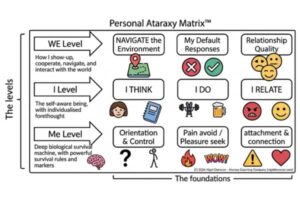
How does our deep biology and our sense of self contribute to how we think and ultimately how we interact with the world around us? I built the “Personal Ataraxy Matrix” below to help people connect their daily interactions with

When the first action isn’t an action at all
There’s a particular way dreams get crushed. Inaction obviously, but even before that, the dismissal of the idea in the first place. It usually happens when the gap between where you are and where the idea would take you is
What is the ROI on how I feel?
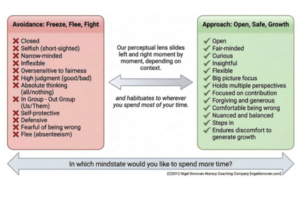
What is the ROI on how I feel? Absurd question, right? It is absurd because we shouldn’t attempt to quantify qualia. But it isn’t absurd, because it represents is a massive missing link that companies cannot see. Companies deal in

Hidden Cost of Gifts
When someone gives a gift, they create an invisible social obligation in the receiver — an implied debt that wasn’t asked for and can’t easily be refused. This piece explores the hidden psychological and relational cost of gifts and what

Attend, drift, avoid?
About 20 years ago I went through a phase of reading those North American motivational books — Napoleon Hill, Dale Carnegie, Emerson, Tolle, that whole shelf. One of them was Nathaniel Branden’s The Art of Living Consciously: The Power of

100% no failure rate
Coachy-mode unnamed dad to his daughter as she puts her boots on for soccer: “You miss 100% of the shots you don’t take.” Daughter with a grin that shows she’s too clever for her dad: “You can’t fail if you

Make rules like you weren’t the boss
New Rule! [specific words or gestures] are now a criminal offence. New Rule! I’m removing that guardrail and bending that rule — it’s slowing us down. New Rule! The Board won’t agree to this — too conservative — so I’ll just not mention it. Forgiveness, not permission. New Rule! That process

Flipping intentions
Those idiots! They are just out for themselves. They don’t care how they impact others…. Last week we focused on the corroding effect on our happiness from Comparison with others. We see their visible successes and not their doubts, fears,

Comparison Corrodes
There’s a famous study from the 1992 Barcelona Olympics that gets wheeled out regularly to make a point about happiness. Bronze medallists, on camera and in interviews, look happier than silver medallists — despite silver being the objectively better result. The explanation
Life objectively good
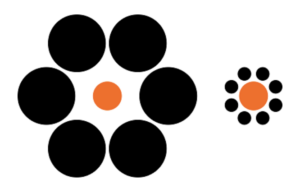
Those two orange circles up there are the same size. I know it, you know it, and your eyes still don’t believe it. Surround something with bigger things and it shrinks. Surround it with smaller things and it grows. Your brain isn’t broken — it just refuses to

Nothing to Nothing is No Time At All
“Eventlessness has no posts to drape duration on. From nothing to nothing is no time at all.” — John Steinbeck, East of Eden Sit with that for a moment – what a beautiful piece of writing. It’s from a passage where Steinbeck is

The Smartest Person in the Room
The smartest person in most rooms he walked into. Technically brilliant. His organisation knew his value — and so did he. But it wasn’t enough. He’d been passed over for promotion. His numbers weren’t where they needed to be. When I first met ___, he

Owning Your Impact
“My boys have a better chance of being well-rounded, rational young men asa result of me committing myself to this journey of figuring out my thoughts.” This quote from a client this week is an example of a father – recognising

The Man I was, killed the man I wanted to be
A feature of the wonderful Aussie blue’s artist, Lloyd Spiegal’s music is the lyrics. Many of his tunes really that hit me in the feels. One example is “The man I was.” Hard to listen to without feeling a little choked up. The key lyric here “The man that I was killed the man that