“All happy families are alike; each unhappy family is unhappy in its own way.”
That’s the opening line of Tolstoy’s Anna Karenina, and the seed of what’s become known as the Anna Karenina Principle. I’ll confess I met it through Jared Diamond rather than Tolstoy. Diamond borrowed it to explain why so few wild animals were ever domesticated. A species has to get a long list of things right, and getting any one of them wrong rules it out. There are lots of ways to fail and very few ways to succeed.
Tolstoy wasn’t the first to notice this. Not a unique or new idea, Confucius for instance got there about 2,400 years earlier.
I’d love to tell you I know that because I’m deeply read in Eastern philosophy. The truth is less impressive. In my twenties I bought a second-hand copy of Confucius and read about thirty pages. One passage stopped me, so I stuck a Post-it note on it, and the book has sat on my shelf ever since with the Post-it still there. Diligent scholarship it was not. But the idea did stick with me.
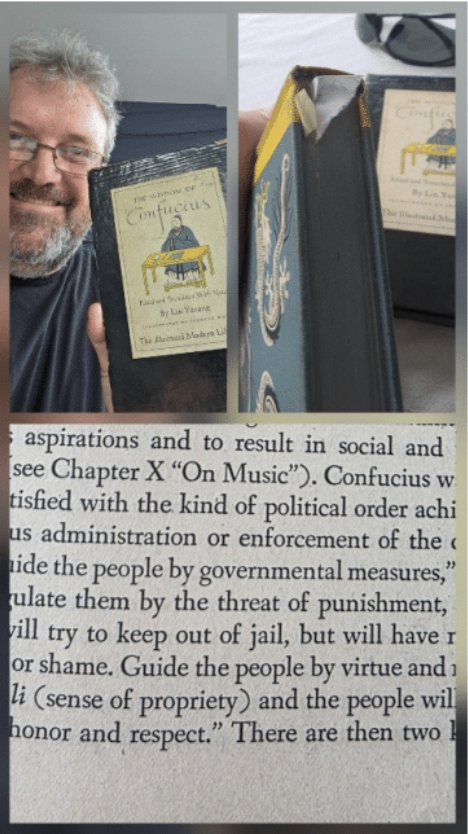
See, here ‘tis!
Here’s the passage, in James Legge’s old translation:
“If the people be led by laws, and uniformity sought to be given them by punishments, they will try to avoid the punishment, but have no sense of shame. If they be led by virtue, and uniformity sought to be given them by the rules of propriety, they will have the sense of shame, and moreover will become good.”
In plain English: lead people with rules and punishment, and they’ll learn to stay out of trouble. Lead them with something worth aspiring to, and they’ll become better.
Humans are very, very good at the first approach. We anticipate what could go wrong and we plug the gap. That habit has served us extraordinarily well. What was farming after all, if not ten thousand years of insurance against starving? Lawmakers, regulators, risk managers and compliance teams are all doing the same honourable work. The catch is that every fix adds a rule. The rules pile up, and eventually the complexity and focus on problem avoidance becomes a risk in its own right.
Most of us run our own lives this way too. A career gets built on not dropping the ball, not getting caught out, and having an answer ready before the question arrives. We get extremely good at not failing.
Not failing doesn’t feel very satisfying.
This is the Anna Karenina Principle and Confucius not being applied deliberately. If there are a thousand ways to be unhappy, closing them off one at a time is a life’s work. Even when you’ve done it, you’re standing in a very well-defended room with nothing much in it. Avoiding the bad things is not the same as building the good ones.
Our brains seem to agree. Moving away from threat and moving towards something we want run on different motivational schemata, and they feel different from the inside. When avoidance works, what you get is relief and safety in the short term. Relief is lovely, but it’s the absence of something rather than the presence of anything. A life built
Happy families aren’t happy because they’ve eliminated every possible source of unhappiness. They’ve got a handful of good things right, and those good things crowd out a lot of the bad without anyone having to chase each problem down.
Leadership teams work the same way. In plenty of respects, an executive team is just a family with a P&L. Like a family, you don’t get to choose who most of them are and you must find ways to work together. Every unhappy leadership team I’ve observed has been unhappy in its own way. There’s the meeting after the meeting, the silent grudge and veto, the two people who haven’t properly spoken since the restructure. Each of those can be diagnosed, workshopped and written into a policy or a performance review. Yet the good teams don’t look like that. They aren’t good because they’ve fixed every fault. They’re good because a few things are right, and the faults don’t get much oxygen.
Culture is no different. You can’t regulate people into wanting to be there. You can only build something worth being part of.
The towards approach is also simpler. That’s the part I keep coming back to, which is a little ironic coming from a chronic overthinker.
If you stopped measuring your week, your team, or your success, by what did or didn’t go wrong, what would you measure it by?
What does good look like?
p.s. The Integrated Leaders Diagnostic can help you think this through for your team. Complete it here (3-5 minutes).