Nobody has ever answered “If you only had twelve months to live, what would you do?” with “Get on top of my inbox.”
Or “nurse a grudge.” Or “argue with strangers on X.”
It’s one of the classic coaching questions, along with its cousin: if time and money were no barrier, what would you do with your time and attention? Both reliably produce the same mindstate. People sit back, breathe out, and get very clear, very quickly, about what matters to them. The mind opens, we get more creative, and problems that seemed insurmountable start to look surmountable.
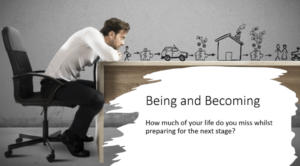
What these questions are really doing is putting you in conversation with a bigger version of yourself — one that can see the trade-offs between activity, purpose and happiness. It’s a wider, more outward-looking view, and it’s generally a happier place to stand. We’re all having that negotiation with our future selves every day, mostly without noticing. Too much living for now and future-you pays the cost. Too much prepping for later and you’re never quite present in your own life [being/becoming article]. Getting the balance right is tricky, because the future is all supposition.
That wider perspective needs mental space to breathe. And when we’re tired, busy or stressed, space is among the first things to go.
Stress narrows our perception, our attention, our flexibility and our creativity. And, importantly for this piece, it narrows how far into the future we’re prepared to care. The brain shifts into “survive now” mode. The planning horizon shrinks from years to this afternoon.
There’s some lovely research (Hershfield and colleagues, 2009) showing that when people think about themselves ten years from now, their brain activity looks more like thinking about a stranger than thinking about themselves. The people who felt least connected to their future selves were also the least inclined to look after them. We already quickly discount our connection to our future selves. Under pressure, that stranger drifts even further away. Future-you becomes “them” — outside your current field of concern. “I’ll look after future me in a bit. First I need to look after present me.”
You can see it in the ordinary decisions of life: more takeaway, another glass, the email rant. Decisions made to fix the crisis of the moment rather than to make things better. It’s a natural, perfectly legitimate trade-off — deal with the tiger now, worry about retirement later. The trouble is that for most of us, most of the time, the tiger is a deadline, not a tiger.
It shows up at work too. A leader who’s been running hot for months starts reacting rather than choosing — firefighting, defending turf, protecting themselves. Not because they’ve forgotten how to think strategically, but because a stressed brain physically shifts its resources away from the parts that do the big-picture thinking. The wider context simply isn’t available until the crisis passes.
So what do you do with this?
There’s plenty you can do, and plenty you can’t. The first thing I’d suggest is simply to notice when you’re under pressure, accept (even if you cannot see it) that your view is probably narrower than usual, and then deliberately go looking for a wider one. This is exactly what good mentors, coaches, advisors and trusted friends are for. They’re sitting in the grandstand while you’re down on the field. They can see things that you cannot.
I’ve made a short explainer video on this: [link]. Feel free to share it.
Have a good weekend,
Nigel
Happier people generate better commercial and community outcomes.