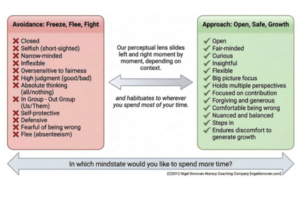
How does our deep biology and our sense of self contribute to how we think and ultimately how we interact with the world around us?
I built the “Personal Ataraxy Matrix” below to help people connect their daily interactions with the deep influence that our ancient biology plays.
Our body and deep biology has drivers for safety and success which have been forged over millennia. To work over ecological time frames, they need to be reasonably generic rules or preferences. Markers for safety.
Let’s work up the levels from the bottom – the foundational, biological level
The “Me Level”
At this level, our mind values feeling oriented and in control of our physical space. Do we know where we are, where we can find food, how to avoid risky places and threats. We also need to do stuff – move, find that food, and avoid that threat. Our brain seeks to minimise risk, find resources, not-waste energy, avoid pain, keep you the same. We, as humans/tribal apes, by comparison with other species, need to be connected to our tribe or group. Our survival is dependent on teamwork and cooperation, therefore our brains highly value feeling securely connected.
The “I Level”
Overlayed on these foundations, we emerge as self-aware beings. Think in terms of “I”. We “think” and reflect. Learn, read, study, train so we can understand how to navigate a modern world. We deploy the deeper need in our current context. I can do things – such as exercise or booze up. Motivational urges that show up as seeking short term, dopaminergic wins, avoiding pain, and avoiding change. This is the realm of our habits. We also build – or undermine – relationships to find our place in the group. Depending on our skills, we can be building quality relationships or building transactional, score keeping, self-protective relationships. These are attempts to meet the deeper underlying “me” level need of secure attachments.
The “We level”
Next level up, we have where we interact with the world around us. How I ‘show-up’ in conjunction with the people and challenges I face, will determine the decisions I make, the relationships I form and the way I tend to respond, my default/habituated actions.
If you want to change how you interact and experience your world, being able to see your (and their) responses with this deeper lens, will empower you to make changes that are more likely to make a difference.
Leadership or personal growth that doesn’t attempt to address the foundations is likely to be short-lived. How you FEEL about the world impacts how you THINK about the moment and ultimately how you ACT.
For long term improvement in your experience of life, or the capability of your team, requires understanding situations in terms of what your brain wants. Which is often very different to what you think you want.